United Arab Emirates · Dubai
Event Production Company in Dubai
Stage, sound, lighting and video designed around your programme, with technical rehearsals and a clear production scope.
The Concept WLL provides event production in Dubai: design, fabrication, AV, installation and live technical operation for your agreed event programme. We connect stage and set decisions with the screens, sound, lighting and crew needed to make the presentation work.
Use this page for a production-led enquiry in Dubai, whether your internal team or agency has already developed the event. The plan starts with the real venue, audience, content and access windows; equipment and scenic choices follow those requirements.
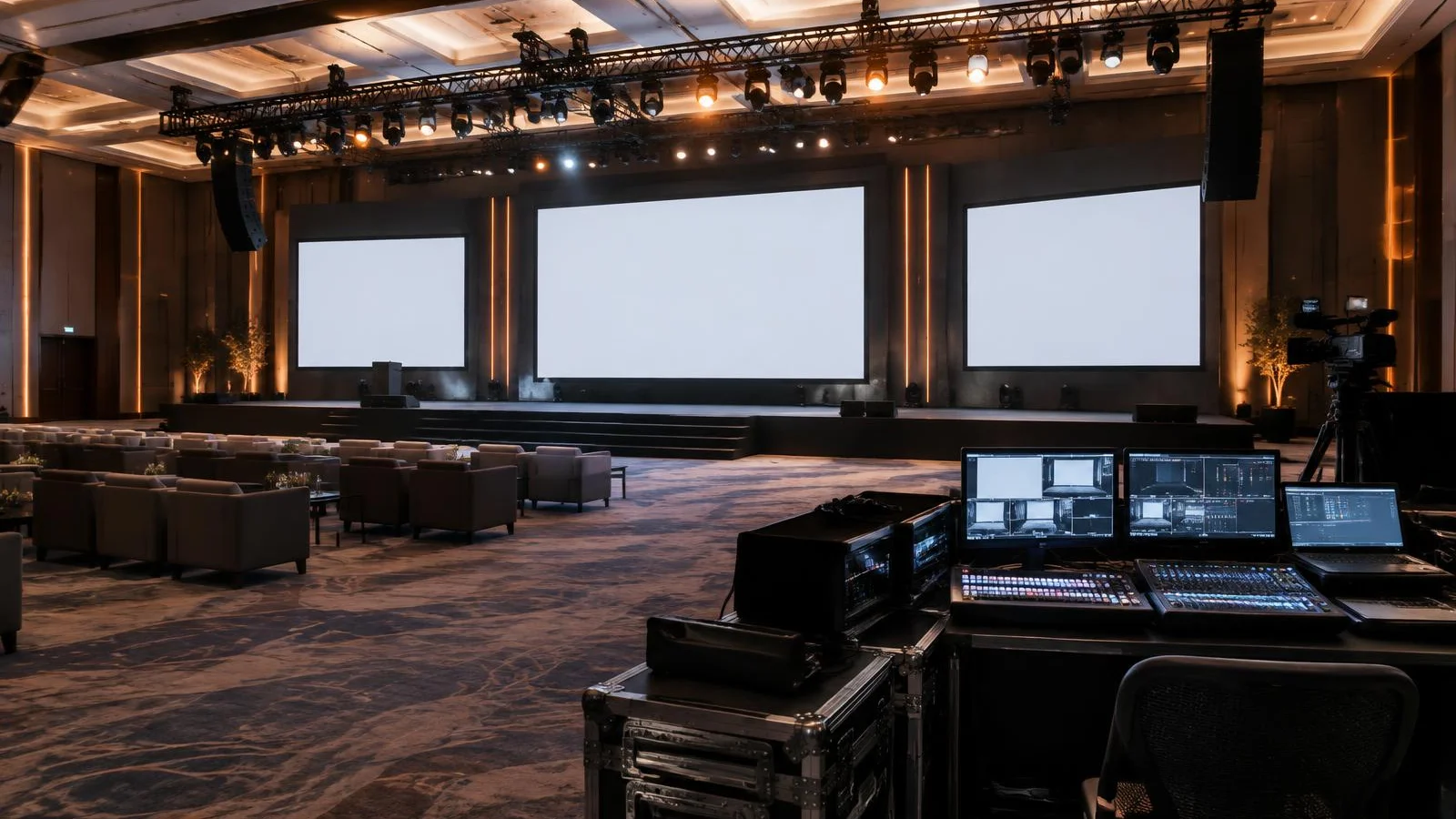
Dubai event production: an independent technical scope
The Concept WLL provides event production in Dubai for conferences, launches, corporate programmes and live shows. The useful starting point is not the largest equipment package but the relationship between the creative brief and the venue. Dubai World Trade Centre publishes its own event-production and technical services, so an external production proposal needs to distinguish venue-controlled services from the systems, scenic build and operators the client is commissioning independently.
If your agency already owns the concept, retain that creative direction and use the production brief to define what must be built and operated. A venue event manager, a client producer and an external technical team may each own different tasks. Confirm their interfaces in writing before design approval: rigging, power, room access, house sound, internet and security. This avoids pricing the same service twice or leaving an essential part of the show between suppliers.
DWTC, Expo City and venue-specific production planning
DWTC and Expo City Dubai are distinct destinations, not generic names for any event hall in the city. A production plan should identify the booked room or space and the current technical documentation, not rely on a venue logo in a presentation. Ask for the loading route, permitted installation methods, rigging arrangements, available power and timings. The final stage and screen layout follows those conditions and the actual seating arrangement.
Arena and theatre briefs require a further distinction between the house system and the temporary show package. Coca-Cola Arena or Dubai Opera appearing in a client's enquiry does not establish approval for external equipment or imply that The Concept has delivered there. Start with the event's technical rider and the venue's response. Record which systems will be supplied by the house, which are additional and where the show team takes operational control.
Launch production that works for cameras and guests
A Dubai product launch can have several audiences at once: guests in the room, media cameras, an online audience and a client team reviewing short clips afterwards. Design the reveal position, camera sightlines and brand canvas together. A screen that looks impressive from the entrance may place the actual product in shadow or force photographers to shoot through the audience. Establish the key image the client wants before deciding the scenic architecture.
Allow for rehearsal with the product or an accurate stand-in. Vehicle reveals, moving products and staged entrances require reviewed movement routes and qualified handling where appropriate. A screen animation should match the reveal cue, not run independently while the product team waits. Confirm who approves the live moment and what the safe fallback is if the mechanism or playback sequence cannot proceed. These practical details are more valuable than an unverified promise of spectacular results.
Multilingual conferences, remote speakers and broadcast feeds
For a Dubai conference, speaker logistics and content arrive from several organisations. Establish a central slide collection process, accepted formats and a deadline that leaves time for testing. Bilingual graphics need enough space for both scripts and should remain readable on confidence monitors as well as the main wall. Remote speakers need a tested connection, a return feed and a named person handling their readiness, not simply a meeting link supplied just before their session.
If the programme is streamed, define the platform, permissions, captioning responsibility and recording deliverables. Venue internet and a public Wi-Fi connection are not interchangeable technical inputs. Request the connection specification and arrange a test before promising a streamed output. Camera operators, switching, audio splits and graphics should be listed as a coherent package; otherwise a quotation for a stage system may not cover the broadcast the client expects.
Dubai production budgeting and venue interfaces
Specify the actual event date and access windows when requesting an event-production quotation for Dubai. A conference with a short overnight load-in has different labour and preparation requirements from the same equipment installed over two working days. Identify which elements can be prebuilt and tested before arriving at the venue. For regional delivery, agree freight, receiving responsibilities, storage and document deadlines before locking the production schedule.
An itemised proposal should describe AV, staging, show control, broadcast, power planning, rehearsals and dismantle. Confirm taxes, venue charges, programme changes and overtime treatment with the quotation rather than infer them from a headline budget. If you need venue selection, invitations or delegate management, use the separate Dubai event-management service. This page is the production-led enquiry destination for the people responsible for the technical show.
LED walls, playback and presenter confidence
Indoor and outdoor LED, content servers and switching are planned as one video chain. Start with what the audience needs to read: a product detail, a financial chart, a speaker or a full-screen film. The nearest viewing distance, ambient light and camera position help determine the screen specification. A wide canvas is useful only when the content team has the correct dimensions and safe areas; stretching a standard presentation across it can make important information harder to follow.
Agree the screen layout and pixel map before animation begins. List every source, including slides, live cameras, remote presenters and branded holding loops. Confidence monitors should give presenters the right information without distracting the audience. For IMAG, recording or streaming, confirm which feeds carry presentation graphics and which remain clean. Test the actual files on the playback system, protect a backup for critical moments, and record who can approve last-minute revisions.
Sound, lighting and an intelligible live programme
Line-array sound, monitor systems and broadcast splits belong in the production discussion alongside intelligent lighting. System selection follows the room and programme, not an equipment list chosen before a site review. A spoken conference needs even coverage and reliable microphones; music and live performance introduce different monitoring and headroom requirements. Account for interpretation, audience questions and recording feeds before deciding how many inputs and operators are required.
Lighting must support both the person in the room and the person watching a camera feed. Separate presenter lighting from scenic effects, specify camera-compatible colour settings and check reflections on screens, lecterns and glossy products. Moving heads, washes and atmospheric effects can support reveals, but any effect that depends on venue permission is confirmed before it enters the cue script. A restrained, well-rehearsed lighting change often communicates a product reveal more clearly than constant movement.
Stage construction, power and suspended loads
Stage, truss and rigging decisions are made together. Draw the presenter route, accessible approach, stair positions, backstage storage and scenic masking before fabricating the set. Ground-supported and suspended structures need different calculations and access arrangements. The venue reviews the permitted load, points and installation method; previous approval for a similar event is not a substitute for the current technical submission. Keep exit routes and firefighting access clear throughout the build and show.
Power and infrastructure cover load planning, distribution and the temporary supply required by the agreed systems. Separate sensitive playback equipment from heavy loads where the electrical design requires it. Identify cable routes, protective ramps and emergency isolation responsibilities. Generators, backup supply and weather protection are specified against the venue and risk assessment rather than assumed to be included everywhere. The quotation should show what is provided, what is venue-supplied and which changes would affect the price.
Show control, broadcast and rehearsal readiness
Timecode, multi-camera, image magnification and streaming workflows are coordinated with stage management and the show caller. A cue sheet names the trigger, action, responsible department and fallback for every significant moment. Confirm who calls the start of each video, who releases a speaker and what happens if a remote connection fails. For streamed events, client account access, recording permission and the intended audience are settled before testing begins.
Protect time for line checks, content tests and a technical rehearsal before opening. A production schedule should distinguish rigging, scenic installation, sound checks, lighting focus, camera checks and presenter rehearsal rather than call them all setup. Record the final approved programme and circulate changes to every operator. After the event, organise recordings and agreed files, remove equipment safely and document venue handover. This technical production service can work alongside your agency or internal team without replacing their event-management role.
Frequently asked questions
What does event production in Dubai include?
The agreed scope can include stage and scenic design, fabrication, LED and video, sound, lighting, rigging coordination, power planning, show control, installation, rehearsal and dismantle. The proposal identifies each department and operator rather than leaving technical delivery undefined.
Can you work with our existing agency or internal event team?
Yes. Bring your creative brief, programme and approved content. We translate them into a technical plan, agree the handovers with your team and venue, and keep changes under a clear approval process.
How is production priced?
Cost follows the stage and system design, content requirements, access conditions, crew shifts and live duration. Request an itemised estimate rather than use an unverified standard price; venue-controlled services and exclusions should be explicit.
Can you include recording, IMAG and streaming?
These workflows can be included alongside the stage system. Confirm the required camera feeds, recording permissions, platform and connection before quotation so playback, switching and audio are designed together.
What should we send with the enquiry?
Send your venue and date, audience size, floor plan, programme, content needs, rehearsal window and any technical rider. If a detail is not settled, mark it as provisional so it is not mistaken for an approved specification.
Plan your Dubai technical production
Send the venue, date, audience size and programme through our existing enquiry form. Add plans and content requirements when available.
Request Event Production · info@the-concept.me · WhatsApp +973 3838 8827