Cybersecurity Exhibition Stand Design for GCC Shows
Exhibition stands for cybersecurity, infosec and digital-risk companies exhibiting in Saudi Arabia and the GCC. From live product demonstrations and threat-visualisation displays to genuinely private meeting space, we design the stand around how security buyers evaluate vendors — credible, technical and discreet.
Request an Enquiry · Free 3D booth mockup
Cybersecurity buyers are sceptical by profession. They notice sloppy cable management, generic stock graphics and demo screens that buffer — and they read all of it as a signal about your product. A cybersecurity exhibition stand has to earn technical credibility in seconds, demonstrate complex products clearly, and give CISOs and security architects somewhere genuinely private to talk. The Concept WLL designs and builds exhibition stands and delivers AV/LED, staging, lighting and event production across Saudi Arabia and the GCC. We are headquartered in Manama, Bahrain, with a production house in Riyadh, and work as an independent contractor for exhibitors at regional security and technology events.
This page explains how we approach cybersecurity exhibition stand design: demonstration infrastructure, visual storytelling for invisible products, private meeting space, connectivity and the practical delivery of the stand. It is written for marketing leads, field teams, founders, agencies and procurement teams in cybersecurity, network security, identity, cloud security and digital-risk management.
Credibility in a sceptical room
Security audiences include CISOs, security architects, SOC leads, government technology teams and procurement specialists — people trained to spot weakness. The stand should communicate what you protect and for whom in one legible message, then prove it with substance: a working demo, a clear architecture story, competent staff with room to talk. We plan the graphics hierarchy, lighting and layout around that sequence, so the stand reads as serious and established before a word is spoken.
One clear proposition
What you protect and who it is for, stated at height; feature detail belongs at reading distance.
Proof over promises
Demo stations and architecture visuals that let the product carry the argument.
A finish that signals rigour
Clean joinery, tidy cabling and considered lighting — details this audience actually notices.
Live demonstrations with real infrastructure
A cybersecurity demo often means a live platform, a simulated attack scenario or a dashboard running on real data. That imposes hard requirements: reliable connectivity, clean power, device management, presenter sightlines and a fallback if the network fails. We plan demo counters with cable routes, screen angles and device security resolved during fabrication, and we ask early whether your demonstration needs wired internet, a dedicated connection or an isolated demo environment. Do not assume venue Wi-Fi will carry a business-critical demo; confirm the options in the exhibitor manual and involve your own technical team in the decision.
Demo stations built for the product
Height, screen angle, queue space and presenter position planned together.
Connectivity planned, not assumed
Documented bandwidth, connection type and an offline or recorded fallback agreed before the show.
Theatre-style demo areas
Small presentation zones with sound and seating where your programme includes scheduled talks.
Making an invisible product visible
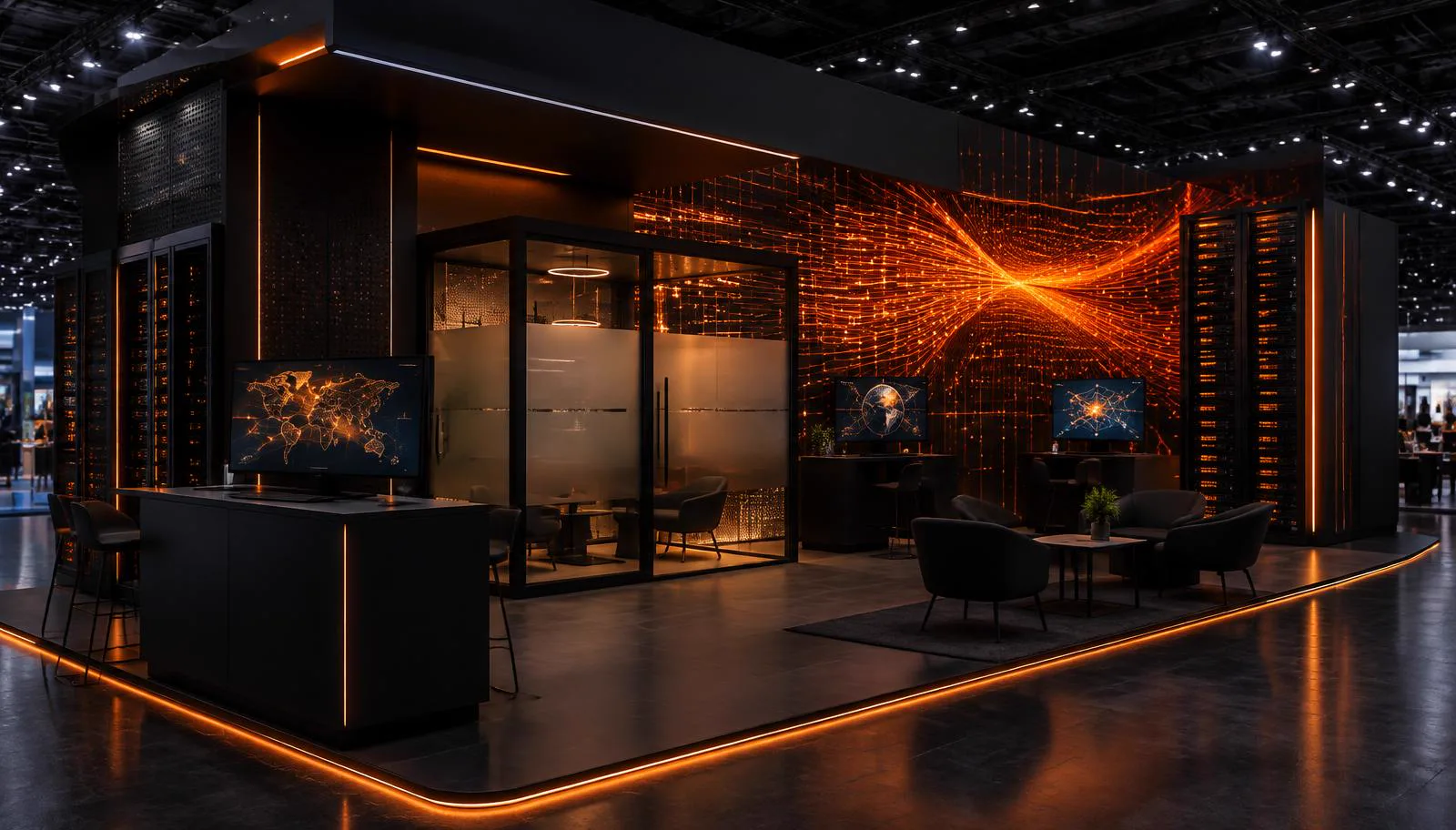
Security products protect things visitors cannot see, which makes visual storytelling the design challenge. Large LED surfaces suit this sector well: threat maps, attack-flow animations, data visualisation and brand motion can all draw attention from the aisle and frame the conversation. Each display should have a defined role — hero visual, demonstration support or information — with content designed for the hall’s actual viewing distances and ambient light. We integrate AV and LED production with the stand layout so mounting, power, audio and sightlines are resolved before fabrication. Your team supplies the content, accounts and devices unless the agreed proposal specifically includes them.
Meeting space that respects the subject matter
Security conversations routinely involve incidents, vulnerabilities, budgets and vendor replacement — topics no one discusses in an open aisle. Depending on the plot and organiser rules, we design semi-screened meeting tables, enclosed pods or a small private room, with ventilation, lighting and acoustic separation considered alongside the furniture. For this sector we treat privacy as a functional requirement, not a luxury: frosted or solid finishes rather than clear glass where discretion matters, positioned so staff retain awareness of the stand and its access routes.
Planning for GCC security and technology exhibitions
Regional events such as Black Hat MEA in Riyadh, LEAP, GITEX Global in Dubai and GISEC attract cybersecurity exhibitors from across the world. The Concept is an independent contractor, not an official contractor or supplier of these events. Dates, venue services, access windows, height limits and approval deadlines are set by each organiser and venue; confirm the current edition’s information directly and share the exhibitor manual with your project team.
A stand plan must match the allocated footprint, open sides, height limits and any rigging, fire-safety, electrical or structural requirements. We review the available documentation, prepare drawings for submission where included in the agreed scope and coordinate changes through the organiser’s approval process. Approval decisions remain with the organiser and venue. We build the physical environment; product claims, certifications and compliance wording remain with your own team.
Budget drivers and requesting a proposal
Cost drivers for a cybersecurity stand usually include footprint and height, structural complexity, the quantity and specification of LED and screens, demo infrastructure, meeting pods, furniture, graphics, freight, installation hours and dismantling. Venue services such as power, internet, rigging and handling are often ordered separately through the organiser. A clear scope identifies what is included, what is provisional and what is ordered directly.
To request a useful proposal, send the show name and edition dates, venue, allocated plot dimensions and open sides, stand number if confirmed, and the exhibitor manual. Add your objectives, the products you will demonstrate, connectivity requirements, meeting capacity, brand guidelines, budget range and internal approval dates. We can then discuss scope, design direction, production and logistics against your actual requirements.
What a cybersecurity stand project can include
- Briefing on objectives, products, audience and show requirements
- Visitor-flow layout and 3D concept development for the allocated footprint
- Production drawings, material selections and organiser submission coordination
- Fabrication management for structure, demo stations, storage and meeting pods
- LED walls, screens, lighting and AV integration within the agreed scope
- Demo device, cable, power and connectivity planning
- Freight, venue access and installation schedule coordination
- On-site build-up support, show-time technical coordination and dismantling
How a cybersecurity stand project runs
Brief
We gather your show details, objectives, products, demo needs and organiser documentation.
Plan
We map visitor flow, demo stations, displays, meeting space and technical dependencies.
Concept & approval
You review the 3D design; drawings are prepared and coordinated for organiser review as agreed.
Production
Approved specifications guide fabrication, graphics and AV integration, with checks before dispatch where practical.
Installation & support
The team coordinates delivery and build-up within confirmed access windows, then supports agreed show requirements.
Dismantling & reuse
After the event, the stand is dismantled and reusable elements are handled according to the agreed plan.
Cybersecurity exhibition stand design: FAQs
Can you design a stand for a live security-platform demo?
Yes. We start with what visitors need to see and do, then plan demo stations, screens, power and connectivity around your product — with an offline or recorded fallback agreed before the show.
Can the stand include genuinely private meeting space?
Yes, subject to plot size and organiser rules. Options range from screened tables to enclosed pods or a small room with frosted or solid finishes, planned with ventilation, lighting and access in mind.
Do you work at Black Hat MEA, GISEC, LEAP and GITEX?
We can work as an independent contractor for exhibitors at GCC shows, subject to scope and availability. We are not an official contractor or supplier of these events; confirm current rules and services with each organiser.
Can you produce the threat-map or demo content for our LED wall?
Your team supplies product content, accounts and devices unless the proposal specifically includes content support. We design the display environment — screens, mounting, sightlines and playback infrastructure — around your content.
Can the stand be reused at other shows?
Reuse can be designed into the structure and graphics. Adaptation depends on future plot dimensions, condition, transport, storage and the equipment needed for each event.
What affects the cost of a cybersecurity stand?
Footprint, structural complexity, LED and screens, demo infrastructure, meeting pods, furniture, graphics, freight, installation and venue services are the usual factors.
What should we send to get a proposal?
Share the show and dates, plot plan, exhibitor manual, objectives, products and demo details, connectivity needs, brand assets, budget range and decision timeline.
Related pages
- Technology exhibition stand design
- Cyber security events industry page
- Exhibition stand services
- AV and LED production
- Free booth mockup
Photo: AI-generated illustration