Technology Exhibition Stand Design for GCC Shows
Custom exhibition booths for software, AI, telecom, cloud, cybersecurity and hardware brands. From demo stations and interactive content to meeting pods, power planning and show-floor delivery, we shape the space around how your technology needs to be experienced.
Request an Enquiry · Free 3D booth mockup
Technology products can be difficult to explain from a brochure or a logo on a wall. A well-planned stand gives visitors a reason to stop, see the product in action and speak with the people who understand it. The Concept WLL designs and builds exhibition stands and delivers AV/LED, staging, lighting and event production across Saudi Arabia and the GCC. We are headquartered in Manama, Bahrain, with a production house in Riyadh, and work as an independent contractor for exhibitors at regional technology events.
Whether you are presenting cloud infrastructure, an AI platform, cybersecurity services, telecom solutions or physical hardware, the design should make the value clear without overwhelming the visitor. This page outlines how we plan technology booth design, from the visitor journey and demonstration format to connectivity, power, organiser approvals and reuse. It is intended for marketing teams, product leads, agencies and procurement teams preparing for a GCC show.
Start with the technology and the visitor journey
Before choosing a shape, screen or finish, decide what a visitor should understand and do. Is the stand introducing a new product, generating qualified conversations, supporting scheduled demonstrations, recruiting partners or giving existing customers a place to meet? A useful brief turns these aims into an experience: a clear invitation from the aisle, a concise explanation, a relevant demonstration and an appropriate next step. The layout should help staff deliver that sequence repeatedly, including during busy periods.
A simple visitor route
Position the welcome point, product story, demo and follow-up conversation in a sequence that is easy to understand from more than one aisle.
Spaces for different conversations
Combine open discovery with quieter meeting areas so that a brief product question and a longer commercial discussion can both happen comfortably.
Clear brand hierarchy
Prioritise one main proposition, then use supporting messages and product names where people have time to read them.
Demo stations that make product value tangible
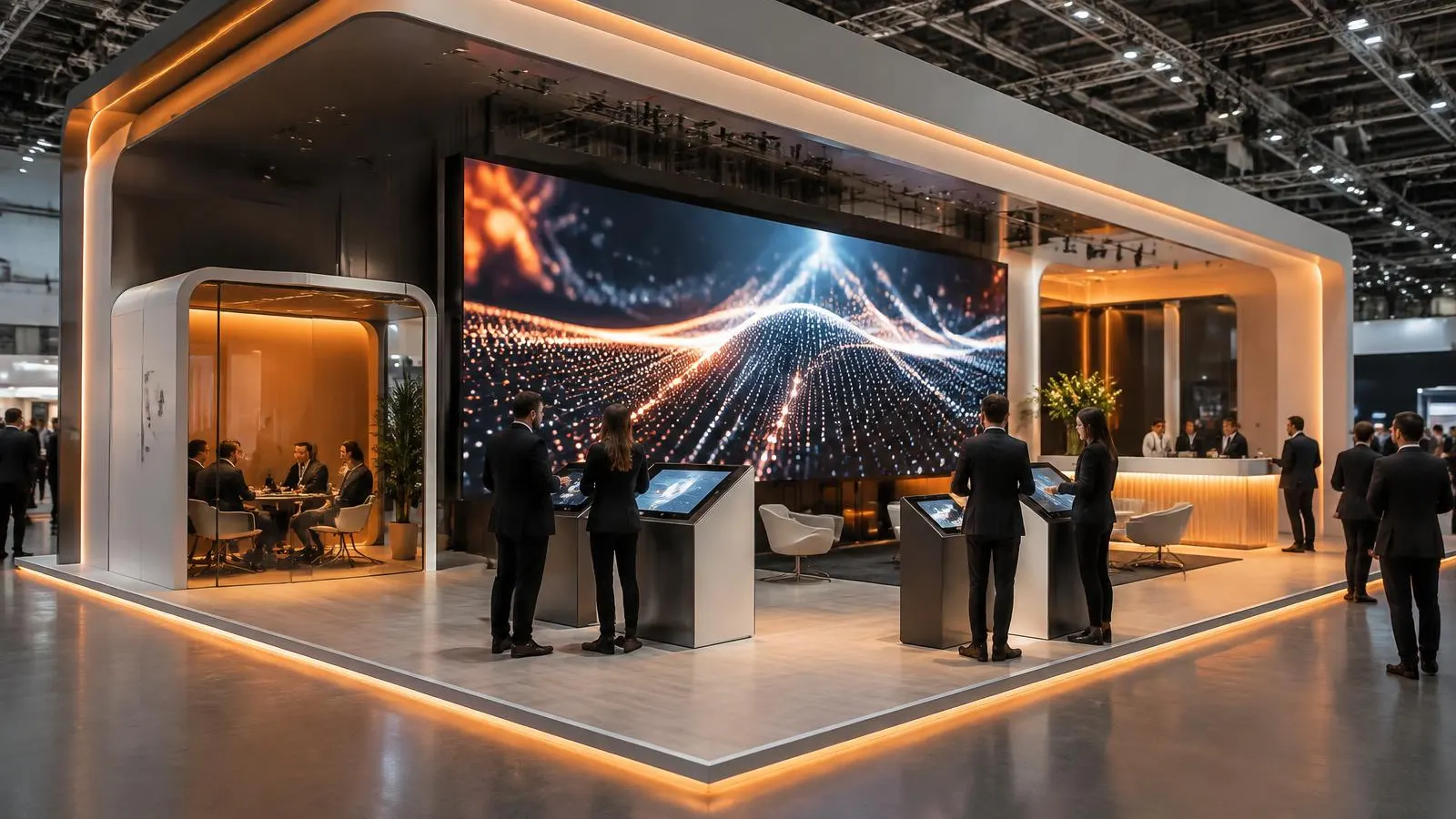
A demonstration is the working heart of many technology stands. Its design depends on the product: visitors may need to touch a device, watch a presenter, compare a dashboard, use a headset or follow a simulation on a large display. We plan station height, screen angle, queue space and staff position together. A demo should be visible enough to attract interest but not so exposed that confidential information or customer data is casually displayed to passers-by.
Hands-on product counters
Allow working space for devices, visitors and staff, with cable routes and security considered as part of the joinery.
Guided presentation zones
Use sightlines, seating or a compact standing area to make a presenter easy to see without turning the booth into an obstruction.
Repeatable demo format
Plan a concise run-of-show, a reset between sessions and a backup version for each critical product demonstration.
Screens, LED and interactive content with a purpose
Screens can communicate a product story, support a presenter or provide motion that draws attention from the aisle. They are most effective when each display has a defined role. A large LED surface can carry a hero visual or a live demonstration; smaller displays can support individual stations. Touchscreens and interactive content invite participation, but only when the task is intuitive, quick to complete and useful to the visitor. We integrate AV and LED production with the stand layout so screen size, viewing distance, mounting, ambient light and audio are considered together.
Network, power and technical planning
Reliable demonstrations begin with an accurate technical schedule. List every screen, media player, laptop, charger, router, lighting circuit and device, with its location and expected load. Include connection types, mounting details and any specialist requirements. This makes it possible to plan sockets, cable routes, ventilation and access before fabrication. Power and internet services may be ordered through the venue or organiser, and available options vary by event; the exhibitor manual and official service forms determine what can be supplied.
Do not assume public Wi-Fi will support a business-critical demo. Establish whether the product needs wired internet, a dedicated connection, a local network or no external connection at all. Confirm bandwidth, latency, firewall settings, authentication and any permitted equipment with the organiser or venue. For sensitive services, involve your own IT or security team early. Network names, credentials and test windows should be shared through appropriate channels, not displayed on a public screen or left on a counter.
Meeting pods, lead capture and brand confidence
A technology exhibition booth often needs to host two different kinds of engagement: a public demonstration and a private commercial conversation. Meeting pods, semi-screened tables or a small enclosed room can provide a quieter setting, depending on the plot and organiser rules. Privacy should be proportionate: visitors need a comfortable conversation, while staff should retain an awareness of the stand and access routes. Ventilation, lighting, sound spill and accessible circulation matter as much as the furniture choice.
Planning for GCC technology exhibitions
LEAP Riyadh, GITEX Global Dubai and Black Hat MEA Riyadh are examples of technology shows where exhibitors may want a stand designed around demonstrations, conversations and high visitor traffic. The Concept is an independent contractor, not an official contractor or supplier of these events. Show dates, venue services, access windows, technical rules and approval deadlines are set by each organiser and venue; confirm the current edition’s information directly and share the exhibitor manual with your project team.
A stand plan must match the allocated footprint, open sides, height limits and any rigging, fire-safety, electrical or structural requirements. We review the available documentation, develop drawings for submission where included in the agreed scope and coordinate changes requested through the organiser’s approval process. Approval decisions remain with the organiser and venue. Do not rely on an old floor plan or a previous edition’s rules as a substitute for the current manual.
Reusable design, budget drivers and getting a quote
The main cost drivers usually include the footprint and height, structural complexity, material and finish choices, quantity and specification of screens, interactive equipment, lighting, furniture, graphics, freight, installation hours and dismantling. Venue services such as power, internet, rigging and handling are separate or organiser-controlled in many events. A clear scope identifies what is included, what is provisional and what needs to be ordered directly. We do not quote on the basis of an assumed show package where the manual is not available.
To request a useful proposal, send the show name and edition dates, venue, allocated plot dimensions and open sides, stand number if confirmed, and the exhibitor manual. Add your objective, product list and dimensions, demo requirements, screen and connectivity needs, meeting capacity, brand guidelines, artwork or references, budget range and internal approval dates. Tell us what your team will supply and what you expect the contractor to provide. We can then discuss scope, design direction, production and logistics in a way that reflects your actual requirements.
What a technology exhibition stand project can include
- Briefing on business goals, audience, product story and show requirements
- Visitor-flow layout and 3D concept development for the allocated footprint
- Production drawings, material selections and organiser submission coordination
- Fabrication management for structure, counters, storage and meeting areas
- Graphics, signage, lighting and AV/LED integration within the agreed scope
- Demo station, screen, device, cable and connectivity planning
- Freight, venue access and installation schedule coordination
- On-site build-up support, show-time technical coordination and dismantling
How a technology stand project runs
Brief
We gather your show details, goals, products, demos, budget and available organiser documentation.
Plan
We map visitor flow, technical dependencies, meeting needs and the best use of the footprint.
Concept & approval
You review the 3D design and layout; drawings are prepared and coordinated for organiser review as agreed.
Production
Approved specifications guide fabrication, graphics and AV integration, with checks before dispatch where practical.
Installation & support
The team coordinates delivery and build-up within confirmed venue access windows, then supports agreed show requirements.
Dismantling & reuse
After the event, the stand is dismantled and reusable elements are handled according to the agreed plan.
Technology exhibition stand design: FAQs
Can you design an exhibition booth for our specific technology?
Yes. We start with what visitors need to see or do, then plan the demo stations, screens, messaging, meeting space and technical requirements around your product and objectives.
Do you work at LEAP, GITEX Global and Black Hat MEA?
We can work as an independent contractor for exhibitors at GCC shows, subject to project scope and availability. We are not an official contractor or supplier of these events. Confirm current dates, rules and services with each organiser.
Can you provide live demos and LED screens?
We design around the AV and interactive elements in the brief and can coordinate AV/LED production. Your team should provide content, devices and accounts unless the proposal specifically includes them; test plans and fallbacks should be agreed early.
How do you plan power and internet?
We document equipment, loads and connection needs, then coordinate requirements against the venue’s current service options and exhibitor manual. Dedicated connectivity and technical approvals depend on the organiser or venue.
Can the booth be reused at other GCC shows?
Reuse can be designed into the structure and graphics. Adaptation depends on future plot dimensions, condition, transport, storage and the equipment needed for each event.
What affects the cost of a technology booth?
Footprint, build complexity, materials, screens, interactive systems, lighting, furniture, freight, installation and venue services are common cost factors. A detailed scope helps separate included work from organiser orders.
What should we send to get a proposal?
Share the show and dates, plot plan, exhibitor manual, objectives, product and demo details, connectivity needs, brand assets, budget range and decision timeline. Include what you will supply and what you want us to manage.
Related pages
- GITEX Global 2026 stand design in Dubai
- Black Hat MEA 2026
- AI and technology events
- Cybersecurity events
- AV and LED production
- Exhibition stand services
- Free booth mockup
Photo: AI-generated illustration