Manama headquarters · Technical event production
Event Production Company in Manama
Conference staging, screens, sound and lighting, with a defined technical scope from room planning to the final cue and derig.
The Concept WLL is headquartered in Manama, Bahrain. We plan and deliver the technical production behind conferences, corporate presentations and live programmes: the stage delegates see, the sound they hear, the screens they follow and the operating team connecting every transition.
For a Manama ballroom conference, the starting point is not an equipment list. It is the room plan, programme and venue access agreement. These determine what can be installed, how speakers move, when rehearsals happen and who has authority to call the show.
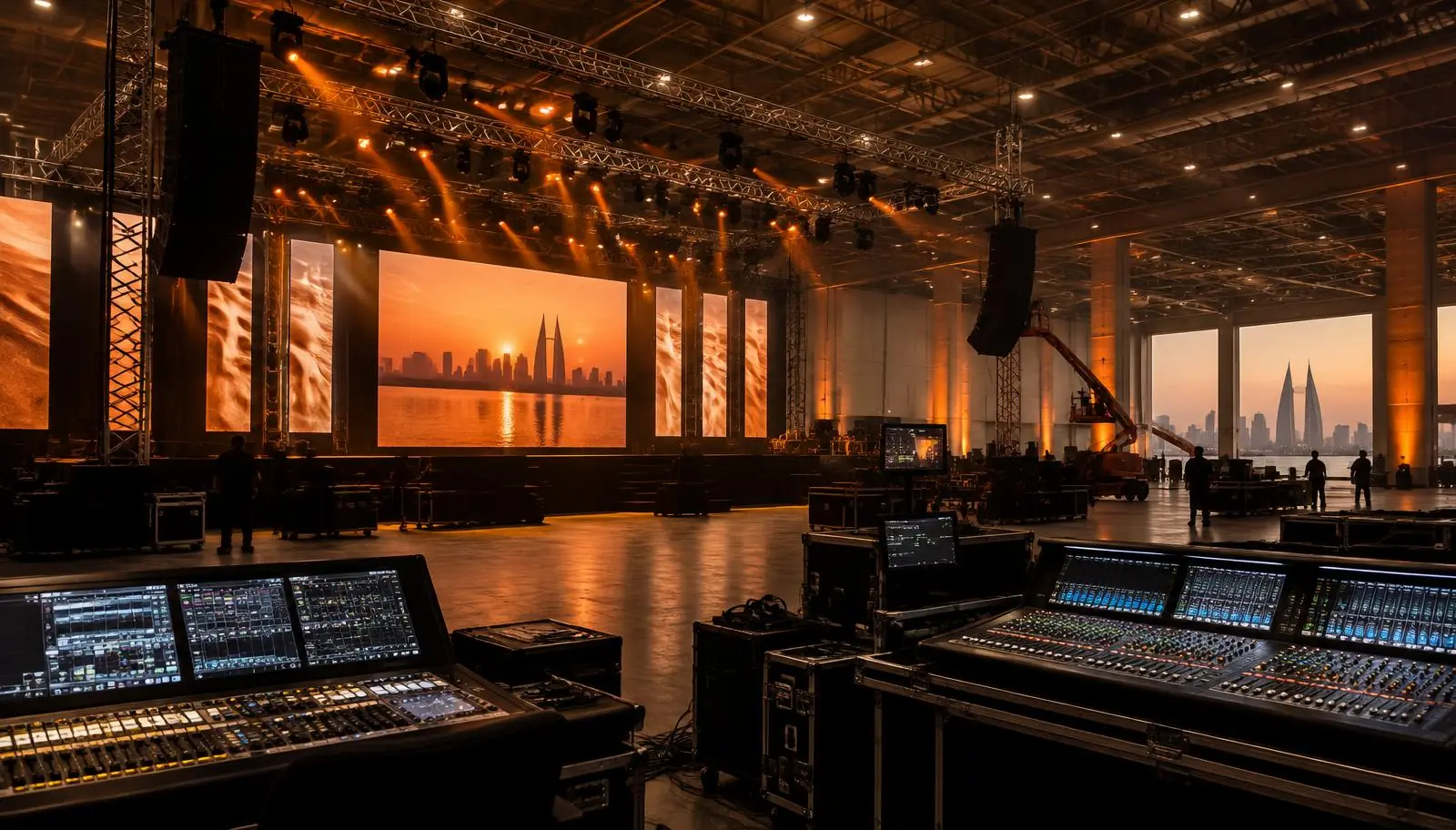
Define the production scope before selecting equipment
Technical production covers staging, scenic elements, video, audio, lighting, rigging coordination, power distribution and show operation. The proposal should identify equipment, crew roles, drawings, rehearsals and venue interfaces, rather than leave these under a general AV allowance.
A conference with panels, remote contributions and interpretation needs a different operating plan from a presentation followed by dinner. We build the technical scope around session formats and transitions, with assumptions and exclusions visible before the organiser approves the package.
Room and stage plans that support the programme
A useful room drawing shows more than a stage rectangle. It positions seating, screens, control desks, camera locations, speaker access and cable routes against the actual ballroom dimensions. Sightlines should be checked from the side seats and back rows, not just the centre aisle.
Stage depth must accommodate panel furniture, lecterns and movement without placing speakers against the screen. Confirm accessibility arrangements, stage-edge treatment and escape routes with the organiser and venue before the layout is signed off.
Main room and breakouts
Give each breakout a microphone plan, display specification and support contact. Check acoustic separation and whether simultaneous sessions need dedicated operators rather than a shared technician.
Speaker preparation
Position confidence monitors and timers where presenters can read them naturally. Agree where speakers wait, receive microphones and enter, especially when panel changes must happen during short transitions.
LED, projection and presentation playback
Choose LED or projection after reviewing viewing distance, ambient light, room depth and the content itself. Dense charts require legible text; a wide branded canvas needs a content template that distinguishes presentation areas from decorative graphics.
Confirm screen dimensions, aspect ratios, playback resolution and the treatment of Arabic and English content before design begins. Test videos with their audio, fonts and slide transitions on the intended system. A file that opens on a laptop is not yet a tested show asset.
- Agree a content submission deadline and name the person approving final versions.
- Separate holding slides, speaker decks, walk-in content and timed videos.
- Specify playback backup and switching arrangements within the agreed scope.
Sound, interpretation and lighting for conferences
Speech intelligibility comes first. Microphone quantities should reflect panels, audience questions and changeovers, with an agreed spare strategy. Loudspeaker coverage must suit the seating layout without obstructing screens or directing unnecessary sound towards reflective surfaces.
Where interpretation is required, confirm languages, interpreter provision, booth positions, audio feeds and receiver distribution responsibilities. Remote speakers, recording and streaming also need defined audio connections; they should not be assumed to work through a single room microphone.
Lighting should make faces readable to delegates and cameras while preserving screen contrast. Coordinate stage washes, lectern positions and house-light settings with the venue. Decorative lighting can support the design, but should not compromise presentation visibility.
Manama venue dependencies to confirm early
For hotel ballrooms in Seef, Bahrain Bay and the Diplomatic Area, request current technical information from the specific property. Confirm loading access, service-lift dimensions, delivery holding areas, ceiling restrictions, shared foyers and working hours. Do not assume neighbouring hotels offer equivalent access or installed systems.
Ask whether house AV is mandatory, optional or limited to particular services. Establish who controls house lighting, who supplies electrical connections and whether external suppliers need venue approval. Protecting finishes and controlling noise during adjacent functions may change the installation sequence.
Exhibition World Bahrain is in Sakhir, outside Manama. Bahrain International Circuit is also a separate Sakhir venue context. If either is being considered, obtain its own access, technical and operational requirements rather than applying a Manama ballroom plan. These references describe planning dependencies, not past projects or venue appointments.
Rigging and power need venue coordination
Suspended screens, truss and lighting require confirmed suspension arrangements and load information. Establish which points may be used, who reviews the design and whether the venue requires nominated riggers. A ceiling feature is not evidence of a usable rigging point.
Power planning should identify available supplies, connection locations, distribution routes and the division between venue electrical work and production distribution. Cable protection, isolation and access must be coordinated before installation. Where overhead suspension is unsuitable, review a ground-supported alternative against floor loads, footprint and sightlines.
- Submit the relevant plots, load information and working methods for review.
- Identify the responsible parties for rigging inspection and electrical connections.
- Confirm approvals before treating the proposed installation as final.
Show control, cue-to-cue rehearsals and show calling
The run of show becomes an operating document when each transition has a cue, an owner and a clear trigger. Agree who authorises programme changes and who calls playback, lighting, microphone handovers and stage movements. Technical operators should not receive competing instructions from several client contacts.
A cue-to-cue rehearsal tests transitions without performing every session in full. Walk through opening playback, speaker entrances, panel resets, remote links and closing cues. Reserve separate time for presenters to practise microphones, slides and confidence monitors.
Who calls the show?
Name the show caller in the scope. We can include that responsibility within the agreed production package, or take cues from the organiser’s designated caller. Document the communication channel and authority to pause for a technical or safety concern.
Agency subcontract or end-to-end delivery
For an agency-led event, we can provide the agreed production package while the agency retains creative approval, client communication and programme ownership. Define who supplies content, manages speakers, books interpretation and obtains event-level permissions. Production responsibility should not silently expand into guest management.
For end-to-end delivery, event management and technical production can sit within one coordinated scope. Even then, distinguish the organiser’s approval role from the production lead’s technical decisions and the venue’s control of its building, infrastructure and operating rules.
- Organiser or agency: programme, speakers, content approval and guest-facing decisions.
- Production team: agreed technical design, installation, operation and show documentation.
- Venue: confirmation of access, infrastructure, house services and approval requirements.
Handover, derig and a comparable proposal
Before doors open, complete a technical handover covering tested playback, microphone assignments, operating positions, communication checks and outstanding restrictions. Record who accepts the room for the show and who remains available for changes.
Derig needs its own access window and sequence. Confirm when guests and venue staff clear the work area, when equipment can move through service routes and who checks the room after removal. Compare proposals on these working hours and responsibilities, not equipment quantities alone; omitted rehearsals or breakdown labour can materially change the scope.
Frequently asked questions
Can you produce a Manama conference for our existing agency?
Yes. We can work within an agency-led delivery structure, with a defined technical package, approval route and responsibility matrix. The agency can retain the client relationship and creative direction.
Can we use the hotel’s existing AV?
Potentially. Ask the hotel for specifications, operating support and any mandatory services. Review those against the programme before deciding which systems to retain, supplement or replace.
Is LED always better than projection in a ballroom?
No. The decision depends on ambient light, viewing distances, content, available depth and budget. Both options need a layout and content check rather than selection by screen size alone.
Who should provide the show caller?
Either the organiser or the production scope can provide this role. Agree it explicitly, including who approves programme changes and how the caller communicates with operators and stage staff.
What if the venue does not permit overhead rigging?
Review ground-supported screens, lighting and scenic options with the venue. Their footprint, stability, floor loading and effect on audience sightlines still need checking before approval.
How much rehearsal time should we reserve?
Base the window on programme complexity, speaker availability and content readiness. Allow system testing before cue-to-cue work, then presenter checks; installation time should not be counted as rehearsal.
Does this page cover Exhibition World Bahrain or the circuit?
This page focuses on Manama production. Exhibition World Bahrain and Bahrain International Circuit are in Sakhir and require separate site-specific planning. Use our Bahrain production page for the wider geographic scope.
What information makes production quotations comparable?
Issue the same room plan, programme, technical requirements and access schedule to each supplier. Ask each to identify crew, rehearsal coverage, show calling, venue charges, exclusions and derig responsibilities.
Send your Manama production brief
Include the venue and room plan, programme/run of show, stage size, screens and content formats, sound/interpretation needs, rehearsal window and budget guidance. Add the event date, audience size and any venue restrictions. If details are provisional, mark them clearly so the proposal separates confirmed requirements from assumptions.
Discuss your production brief · info@the-concept.me · WhatsApp +973 3838 8827